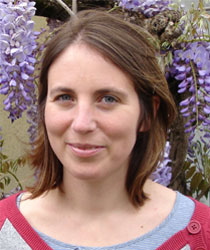
Corinne Vacher


Host-parasite interaction between a young pine tree and the fungi species Armillaria ostoyae

Host-parasite interaction between a young pine tree and the fungal species Armillaria ostoyae  - This interaction corresponds to one link in the network represented below.


Architecture of the interaction network between tree species and parasitic fungi species in the French forests
Ecological network between tree species and parasitic fungal species in the French forests - This network is complex but it represents only a small proportion of the interactions involving trees.


Beech leaves

A beech leaf - The canopy of a single beech tree hosts several hundreds of fungal species. It also hosts bacteria, insect herbivores and their parasitoids... Most of my work focuses on these numerous and complex interactions between trees and other organisms. 


Dr. Corinne VACHER

Researcher in Ecology


Contact details


Education & Positions 

  • Since 2009 - Permanent staff researcher (CR1) at INRA
  • 2001-2004 - Doctorate of Science in Ecology and Evolution, University of Montpellier, France 
  • 1998-2001 - Ecole Normale Supérieure, Cachan, France 

Current research topics

  • Ecological networks - The diversification of species and their interactions during the course of evolution has produced ecological networks with complex topologies. The aim of my work is to better understand the mechanisms underlying such topologies.
  • Microbial communities - Phyllosphere, the habitat provided by the leaves of living plants, is one of the largest microbial habitat on Earth. It supports diverse and complex microbial communities, including many genera of bacteria and fungi. The aim of my work is to better understand the mechanisms underlying the diversity and composition of these microbial communities.

Current students
  • Tristan Cordier (PhD student, 2008-present) : Effect of climate change on the diversity and composition of fungal assemblages associated with European beech (Fagus sylvatica) - Advisor: M.L. Desprez-Loustau, Co-advisors: C. Robin, C. Vacher  
  • Jean-Benoist Leger (PhD student, 2010-present) : Modelling the topology of ecological networks with statistical models for heterogeneous random graphs -  Advisor: J-J. Daudin, Co-advisor: C. Vacher 
  • Boris Jakushkin (PhD student, 2011-present) : Effect of intra-specific genetic variation in pedunculate oak (Quercus robur) on the diversity and composition of associated microbial communities - Advisor: C. Robin, Co-advisors: V. Fievet, C. Vacher   

Previous research topics

  • Resistance evolution to pesticides and drugs
  • Gene flow between crops and weeds

Publications 


Submitted
  • Leger, J-B., Vacher C, Daudin, J-J. Detection of topologically homogeneous subsets in graphs (submitted)
2012
  • Cordier, T., Robin, C., Capdevielle, X., Desprez-Loustau, M-L., Vacher C. 2012. Spatial variability of phyllosphere fungal assemblages: genetic distance predominates over geographic distance in a European beech stand (Fagus sylvatica L.). Fungal Ecology, in press
2010-2011
  • Philibert, A.,  Desprez-Loustau, M-L.,  Fabre, B., Frey, P., Halkett, F., Husson, C., Lung-Escarmant, B., Marçais, B. Robin, C., Vacher, C., Makowski,  D.  2011. Predicting invasion success of forest pathogenic fungi from species traits. Journal of Applied Ecology 48(6): 1381-1390

  • Vacher, C., Kossler, T. M., Hochberg, M., Weis, A.E. 2011. Impact of Interspecific Hybridization between Crops and Weedy Relatives on the Evolution of Flowering Time in Weedy Phenotypes. PloS ONE 6(2): e14649
  • Daudin, J-J., Pierre, L., Vacher, C. 2010. Model for heterogeneous random networks using continuous variables and an application to a tree-fungus network. Biometrics  66:1043-1051.
  • Vacher, C., Daudin, J-J., Piou, D., Desprez-Loustau, M-L.  2010. Ecological integration of alien species into a tree-parasitic fungus network. Biological Invasions  12:3249-3259.
  • Mariadassou, M., Robin, S., Vacher, C. 2010. Uncovering latent structure in valued graphs: a variational approach. Annals of Applied Statistics 4(2):715-742.
  • REX Consortium. 2010. The skill and style to model the evolution of resistance to pesticide and drugs. Evolutionary Applications 3(4): 375-390.
2007-2008
  • Vacher, C., Vile, D., Helion, M. Piou, D., Desprez-Loustau, M-L. 2008. Distribution of parasitic fungal species richness: influence of climate versus host species diversity. Diversity and Distributions 14(5):786-798
  • Vacher, C., Piou, D., Desprez-Loustau, M-L. 2008. Architecture of an antagonistic tree/fungus network: the asymmetric influence of past evolutionary history. PloS ONE  3(3):e1740. 
  • REX Consortium. 2007. Structure of the scientific community modelling the evolution of pesticide and drug resistances. PloS ONE 2(12):e1275 
2005-2006
  • Vacher, C., Bourguet, D., Desquilbet, M., Lemarié, M., Ambec, S. and M.E. Hochberg. 2006. Fees or refuges: which is better for the sustainable management of insect resistance to transgenic Bt corn? Biology Letters 2: 198-202
  • Vacher, C., Brown, S. and M.E. Hochberg. Avoid, attack or do both? Behavioral and physiological adaptations in natural enemies faced with novel hosts. 2005. BMC Evolutionary  Biology 5: 60 
  • Weis, A.E., Winterer, J. A., Vacher, C., Freshwater, M., Kossler, T.M., Young, C.A. and G. LeBuhn. 2005. Phenological assortative mating: the nature and consequences of its frequency-dependance. Evolutionary Ecology Research 7: 161-181.
2003-2004
  • Vacher, C., Weis, A.E., Hermann, D., Kossler, T.M., Young, C. and M.E. Hochberg. 2004. Impact of ecological factors on the initial invasion of Bt transgenes into wild populations. Theoretical and Applied Genetics 109: 806-814
  • Vacher, C., Bourguet, D., Rousset, F., Chevillon, C. and M.E. Hochberg. 2004. High dose refuge strategies and genetically modified crops – Reply to Tabashnik et al. Journal of Evolutionary Biology 17: 913-918
  • Vacher, C., Bourguet, D., Rousset, F., Chevillon, C. and M.E. Hochberg. 2003. Modelling the spatial configuration of refuges for a sustainable control of pests: the case of Bt cotton. Journal of Evolutionary Biology 16: 378-387

Document made with Nvu

Last updated 10/11/2011